
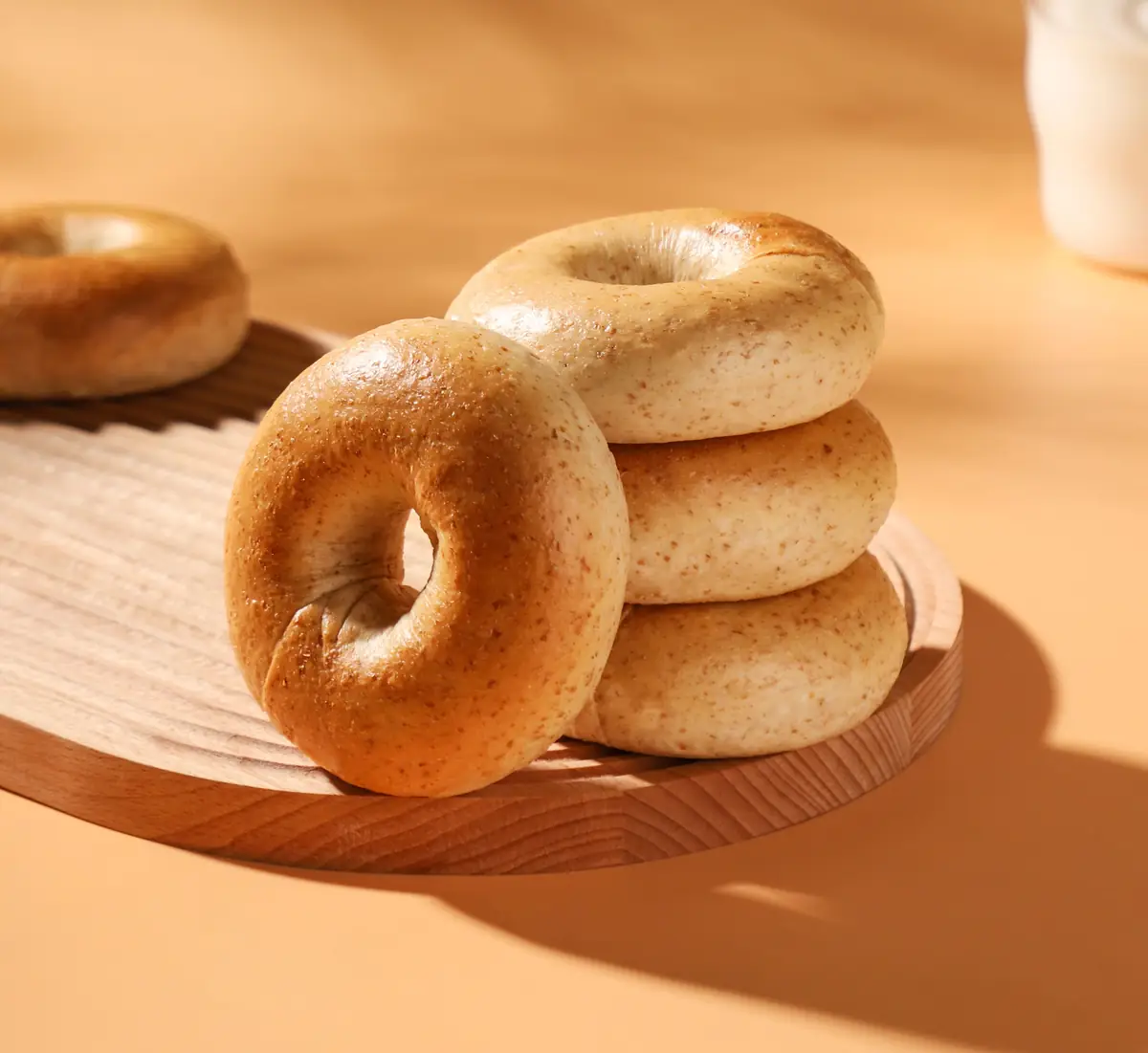
Classic bagels with a crisp, chewy crust and soft, dense interior—made completely oil-free for a lighter, health-conscious twist.
Add the bread flour, water, yeast, sugar, and salt to the bowl of the dough maker.
Mix the ingredients for about 20 minutes until the dough is smooth.
Check gluten development: the dough should stretch into a thick, elastic membrane and tear with slightly jagged edges.
Transfer the dough to a work surface and divide it into 6 equal portions.
Shape each portion into a smooth ball.
Cover with plastic wrap and let rest at room temperature for 10 minutes.
Working with one piece at a time, roll the dough into an oval.
Flip it over and roll it up tightly from top to bottom, pinching the seam to seal.
Roll the dough into a rope about 7–8 inches long.
Flatten and slightly widen one end, wrap it around to meet the opposite end, and pinch firmly to form a secure ring.
Place each shaped bagel on its own small square of parchment paper.
Proof in a warm, humid environment (about 90°F) for 30 minutes, or until the bagels have increased to about 1.5 times their original size.
Near the end of the proofing period, bring the water and sugar to a boil in a wide pot.
Reduce to a gentle simmer—bubbles should be small and tight.
Meanwhile, preheat the oven to 400°F.
Carefully lower the bagels—parchment and all—into the simmering water.
Poach for 30 seconds per side.
Remove with a slotted spoon, allowing excess water to drain, and transfer immediately to a parchment-lined baking sheet.
Place the poached bagels into the preheated oven right away.
Bake for 18–20 minutes, or until the tops are golden brown.
Transfer to a wire rack and let cool completely.
Use Ice-Cold Water: Helps control dough temperature during mixing, preventing premature fermentation and ensuring the bagels develop their signature chew.
Avoid Over-Proofing: Bagels only need a light proof—about 1.5× their original size. Over-proofed dough can deflate during poaching or baking.
Seal the Dough Well: Pinch all seams very securely during shaping. Poorly sealed ends may separate while poaching.